

Product Knowledge
How to Choose the Best Plastic PVC Curtain: A Complete Buyer's Guide
You've probably walked through a clear plastic curtain in a warehouse or grocery store without giving it a second thought. But when it's time to buy a plastic PVC curtain for your own space, the options can feel overwhelming. Cold drafts driving up your heating bill? Dust from a workshop migrating into your living area? Noise from machinery making conversation impossible? A plastic PVC curtain might be exactly what you need. This guide will walk you through every decision so you can buy with confidence. You'll learn how to match curtain specifications to your environment, calculate real savings, and avoid the mistakes that lead to early replacement.
Key Takeaways
- A plastic PVC curtain creates a flexible, cost-effective barrier that controls temperature, dust, and noise without blocking foot traffic or vehicle access.
- The three most critical selection factors are the thickness needed for your traffic conditions, the temperature range your curtain must survive, and the right mounting hardware for your doorway.
- You can realistically save hundreds of dollars annually per doorway on energy costs alone, which often pays back the entire curtain investment within months.
Why a Plastic PVC Curtain Might Be the Solution You Need
Think about the spaces in your home or business that feel impossible to manage. Maybe it's a loading dock that hemorrhages heated air every time a forklift drives through. Or a workshop where sawdust finds its way onto every surface in the adjacent room. Perhaps it's a cold storage area where your refrigeration unit runs constantly, struggling against warm air infiltration from the outside.
These are the exact problems a plastic PVC curtain was designed to solve. Unlike rigid doors that require hands to open and close—and often get left open for convenience—a plastic curtain creates a self-closing barrier. You pass through it, and it falls back into place immediately. The result is a continuous seal that keeps conditioned air where it belongs, blocks airborne contaminants, and dampens sound transmission.
The mistake many buyers make is grabbing the cheapest option online without considering their specific conditions. Curtains that aren't rated for cold temperatures turn brittle and crack. Ones that are too thin blow open in the slightest breeze. This guide is built to help you skip those expensive do-overs and get the right curtain the first time.
What Exactly Is a Plastic PVC Curtain and How Does It Work?
A plastic PVC curtain is exactly what it sounds like—a flexible barrier made from polyvinyl chloride (PVC) strips or sheets, designed to hang over an opening and allow passage while maintaining separation between two areas. The material itself is what makes this possible. PVC is durable, flexible, and can be engineered with different properties depending on what additives manufacturers blend into the resin.
Material Composition and Properties
The base material begins with PVC resin, which by itself would be rigid and brittle. Plasticizers are added to give the curtain its signature flexibility and softness. These chemical additives determine how pliable the strips remain at various temperatures. A curtain designed for a freezer environment uses special low-temperature plasticizers that keep the material flexible well below 0°F, while standard-grade curtains start to stiffen around freezing.
Here's why this matters in practice: when a standard PVC curtain stiffens in cold conditions, the strips lose their ability to overlap and re-seal after someone passes through. Forklift operators end up pushing stiff, separated strips aside rather than parting a unified barrier, and the thermal seal is compromised. Low-temperature plasticizers solve this by altering the molecular behavior of the PVC—they prevent polymer chains from locking together in cold conditions, which is what causes rigidity. This is the same principle behind winter-grade electrical cords remaining flexible while standard cords turn stiff.
Beyond flexibility, manufacturers can add UV stabilizers to prevent sun damage, anti-static compounds to dissipate electrical charges in electronics manufacturing areas, and pigments to create tinted or fully opaque variations. Food-grade PVC curtains meet FDA and USDA standards for incidental food contact, making them suitable for food processing facilities where strict cleanliness regulations apply.
Common Forms: Strip Curtains, Rolls, and Panel Curtains
Strip curtains are the most recognizable form. Individual vertical strips of PVC hang from a header plate, overlapping each other slightly to create a continuous barrier. The strip design allows for partial replacement—if one strip gets damaged, you replace just that strip instead of the entire curtain.
Roll-up curtains use a single sheet of PVC wound onto a roller mechanism. These work well for larger openings that don't require constant pass-through access. When you need the opening clear, you simply roll the curtain up.
Panel curtains consist of wider, fixed panels that offer more wind resistance and better insulation values. These are common in cold storage applications where the opening stays sealed most of the time but still needs occasional access.
The Many Uses of Plastic PVC Curtains: From Warehouses to Home Garages
Plastic PVC curtains show up in more places than most people realize. Understanding where they excel helps you recognize whether your own situation is a good fit.
Industrial and Commercial Applications
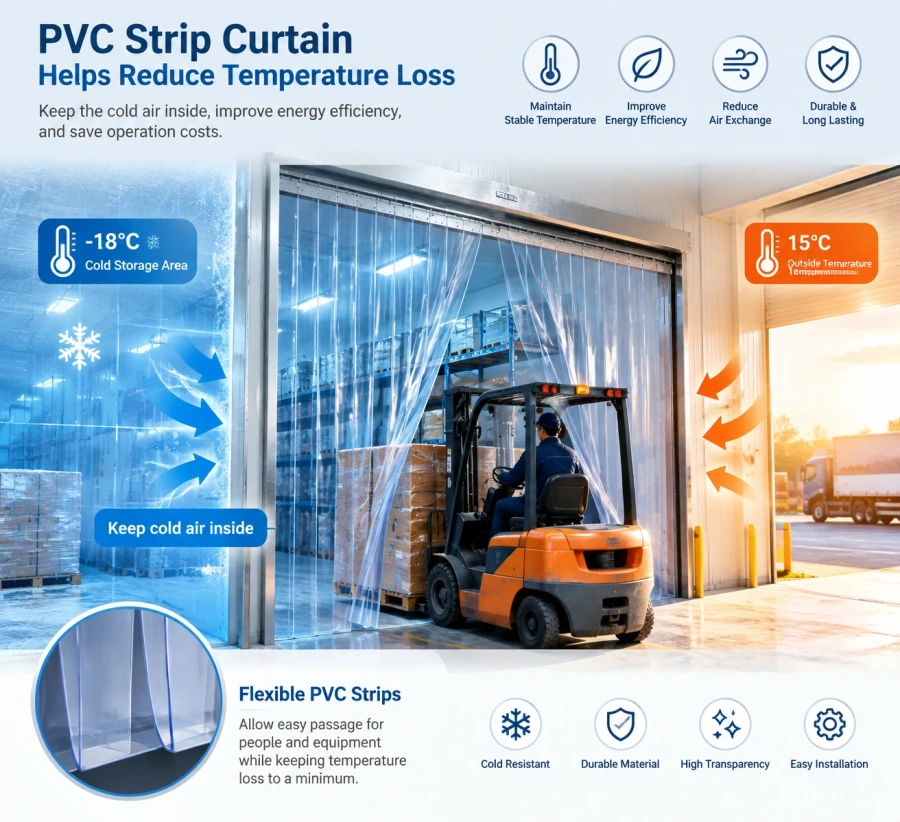
In warehouses and distribution centers, PVC strip curtains installed over loading dock doors reduce heat loss dramatically. Forklifts pass through effortlessly while the curtain falls back into place, maintaining interior temperatures. A typical unheated warehouse can see temperature swings of 20°F or more when dock doors stay open, and curtain barriers cut that substantially.
Cold storage facilities and walk-in freezers represent one of the most demanding applications. Here, the curtain must remain flexible at temperatures as low as -40°F. Special low-temperature PVC compounds handle this without cracking or becoming rigid. In food processing plants, curtains must also meet regulatory requirements for cleanliness and incidental food contact. Food-grade PVC curtains are formulated without harmful phthalates and withstand frequent washdowns with cleaning chemicals.
Cleanrooms and electronics manufacturing facilities use anti-static PVC curtains to control particulate contamination and prevent electrostatic discharge that can damage sensitive components. Welding shops install specially tinted curtains that block harmful UV radiation while still allowing visibility and passage.
Residential and Small Business Uses
You don't need a massive industrial facility to benefit. Home garages and workshops use PVC curtains to create flexible dividing walls, keeping wood dust, paint overspray, or welding fumes contained in a work zone while preserving the rest of the garage for parking or storage.
Small businesses like breweries, bakeries, and restaurants install curtains over walk-in cooler doorways. The constant opening and closing of a rigid door puts strain on hinges and seals, and many employees prop doors open during busy service periods. A strip curtain solves both problems: it's always closed, yet always passable.
Livestock and agricultural applications include barn doorways where curtains keep out wind and pests while allowing animals and equipment to move freely. The curtains also help control temperature in greenhouse entryways.
Key Factors to Evaluate Before Buying a Plastic PVC Curtain
Here is where most buying guides stop at surface-level advice. You need to match your curtain to your actual conditions, and that means understanding a few technical specifications.
Thickness and Temperature Tolerance
Curtain thickness is measured in mils (thousandths of an inch) or in gauge. Standard residential and light commercial curtains often range from 0.06 to 0.08 inches thick. Heavy-duty industrial curtains go up to 0.160 inches or more. Thicker strips resist wind better and last longer under heavy forklift traffic, but they're also heavier to push through and cost more upfront.
Your decision should match your traffic type. For pedestrian-only doorways, 0.060-inch strips work fine. For pallet jack and occasional forklift traffic, step up to 0.080 inch. Frequent forklift traffic or exterior doorways with wind exposure demand 0.120 inch or thicker. High-wind exterior openings may need 0.160-inch strips with heavier overlap.
Temperature tolerance is equally critical. Standard PVC curtains typically perform well down to about 20°F before they start stiffening. For freezer and cold storage applications from -20°F to -40°F, you need low-temperature PVC specifically formulated with cold-resistant plasticizers. On the hot side, standard PVC can handle continuous exposure up to about 140°F. High-temperature compounds extend that range to around 180°F for applications near ovens, dryers, or industrial heat sources.
A common mistake to avoid: buying a curtain based on thickness alone without checking the temperature rating. I've seen small bakery owners purchase heavy-duty 0.120-inch strips for their walk-in freezer, assuming thicker means better, only to discover the strips cracked within weeks because the plasticizer formulation wasn't rated for subzero temperatures. The strips were thick enough but chemically wrong for the environment. Always verify the manufacturer's stated operating temperature range matches your coldest and warmest conditions—thickness and temperature tolerance are separate specifications, not interchangeable.
Transparency, Color, and UV Resistance
Clear PVC curtains maximize visibility and natural light transmission. This is the default choice for most applications where seeing through the barrier improves safety and workflow. Over time, clear PVC can yellow with UV exposure, so outdoor or sun-exposed installations benefit from UV-stabilized formulations.
Tinted curtains in colors like red, green, or amber serve specific purposes. Welding curtains use dark green or amber tinting to filter harmful UV and blue light, protecting bystanders while allowing welders to be seen. Red-tinted strips can mark hazard zones or restricted areas visually.
Opaque or solid-color curtains offer complete visual separation. Black strips block light entirely, making them ideal for photography darkrooms or areas where light contamination matters. Ribbed or textured surfaces on some strips reduce glare and hide minor scratches better than smooth clear surfaces.
Anti-static curtains contain conductive additives that dissipate static charges safely to ground. These are required in electronics assembly, server rooms, and any environment where a static discharge could damage components or ignite flammable vapors. You can identify anti-static PVC by its slightly darker tint and a surface resistivity rating typically under 10⁹ ohms per square.
Customization Options and Hardware
Most PVC curtain suppliers offer custom sizing. You specify the width and height of your opening, and strips are cut to length with mounting hardware sized to match. Strip width is another choice: standard widths of 4, 6, 8, and 12 inches are common. Narrower strips offer more flexibility and easier passage but require more individual strips to cover an opening. Wider strips are stiffer and more wind-resistant.
The mounting system determines how your curtain hangs and how easy it is to install or remove. Standard header plates are aluminum or galvanized steel channels that hold the strips via locking bars or individual clips. Slide-track systems let you push the entire curtain to one side for full clearance when needed. For openings that need occasional complete access, this feature is worth the upgrade.
Consider the door frame material when selecting hardware. Concrete, steel, and wood all require different fasteners and may need different bracket styles. Some mounting systems are surface-mounted, while others recess into the opening for a cleaner look and better seal.
Another critical mistake: ordering strips cut exactly to the opening height. Strips need about one inch of extra length to drape against the floor and create a proper seal. Ordering strips that just barely reach the floor—or worse, hover above it—creates a permanent gap that lets air, dust, and pests pass underneath. Conversely, strips that drag by three or four inches curl, collect dirt, wear prematurely, and create tripping hazards for foot traffic. Measure from the top of your mounting header to the floor, then add one inch. That is your strip length. For uneven floors, add slightly more and plan to trim after installation for a consistent bottom line.
Installation and Care: Making Your Plastic PVC Curtain Last
Installing a plastic PVC curtain is straightforward enough that most people can handle it over a weekend, but a few details make the difference between a curtain that works perfectly and one that frustrates you.
Step-by-Step Installation Overview
Start by measuring your opening carefully. The header plate needs to span the full width, and strips should extend past the floor by about one inch for a proper seal. Strips that are too short leave a gap at the bottom; strips that are too long drag and curl, creating a tripping hazard and wearing out faster.
Here's a practical installation walkthrough for a typical garage or workshop doorway. You're standing in front of an 8-foot-wide by 7-foot-tall opening with a wooden header beam above it. You've ordered a curtain kit with an 8-foot aluminum header plate, pre-cut 0.080-inch clear strips at 85 inches long (7 feet plus 1 inch), and included mounting brackets and lag bolts.
Start by holding the header plate against the wall above the opening, centered side-to-side, and mark your bracket hole locations with a pencil. For wood framing, pre-drill pilot holes slightly smaller than your lag bolt diameter to prevent splitting. For concrete or steel, you'll need a hammer drill with masonry bits and appropriate sleeve anchors—standard plastic wall anchors will not hold the weight of a full curtain assembly under daily use.
Mount the brackets first, then set the header plate onto them and tighten all hardware. Check for level with a carpenter's level before fully torquing the bolts. Even a quarter-inch slope across eight feet creates visibly uneven strip hang and reduces overlap at the low end. Once the header is secure, slide your strips into the channel one at a time, ensuring each strip overlaps its neighbor by about 25% of its width. Full overlap provides better sealing; partial overlap saves material costs but performs worse. For exterior openings or cold storage, full overlap is non-negotiable. Tighten the locking bar or clips evenly, checking that strips hang straight and uniform.
Cleaning and Maintenance Best Practices
Regular cleaning extends the life of your curtain significantly. Dust and grime on clear PVC eventually scratch the surface, reducing visibility and making the curtain look worn. A simple mix of mild soap and warm water, applied with a soft cloth or sponge, handles most cleaning needs. Avoid abrasive cleaners, scouring pads, or harsh solvents that can damage the plasticizers and cause brittleness.
For heavier grease or residue common in food processing or industrial settings, use a PVC-compatible cleaner specifically formulated for flexible vinyl. Rinse thoroughly and dry with a soft cloth to prevent water spotting.
Strip replacement is one of the major advantages of this product. When an individual strip gets scratched, torn, or damaged, you simply remove that strip from the header and slide in a replacement. You can keep a few spare strips on hand and swap them out in minutes, keeping the entire curtain functional for years without a full replacement.
Is the Investment Worth It? Calculating the Real Savings from a Plastic PVC Curtain
Let's talk numbers, because this is where a PVC curtain often sells itself. The upfront cost of a quality PVC strip curtain for a standard 8-foot by 10-foot doorway typically runs between $300 and $800, depending on thickness and features. That's a fraction of what a high-speed roll-up door or an air curtain system costs.
Energy Cost Reduction Examples
The savings come primarily from reduced energy loss through open doorways. Every time conditioned air escapes and outside air enters, your HVAC or refrigeration system works harder to compensate. A PVC curtain reduces this air exchange by 50% to 75%, depending on traffic frequency and strip thickness.
Here's a simplified way to estimate your annual savings per doorway. Multiply the opening's square footage (width × height in feet) by the temperature difference between inside and outside (°F) by the hours the doorway is in use daily, then by your local energy cost per therm or kWh. Curtains reduce this loss by roughly 60% on average.
For a concrete example, take an 8 ft × 10 ft warehouse doorway in a climate with a 30°F average temperature difference between inside and outside during heating season. If that doorway sees traffic and stays open-equivalent for about four hours daily over a five-month heating season, the energy loss is roughly 80 therms. At $1.20 per therm, that's about $96 saved annually. Add similar cooling-season savings, and you're past $150 per year for just one doorway. Your $400 curtain pays for itself in under three years from energy alone—and that's before counting improved worker comfort, reduced dust cleanup, or extended equipment life from less-frequent cycling.
Consider a real scenario: a small craft brewery with a 6 ft × 8 ft walk-in cooler doorway. The cooler maintains 38°F while the brewhouse sits at 75°F—a 37-degree difference. Before installing a curtain, the refrigeration compressor cycled on roughly 18 hours per day during summer months. After installing a 0.080-inch clear PVC strip curtain with full overlap, runtime dropped to about 14 hours daily. That four-hour reduction, at an average compressor draw of 3.5 kW and a utility rate of $0.12 per kWh, saves roughly $60 per month during peak cooling season. The $350 curtain paid for itself before summer ended, and the compressor—now cycling less frequently—faces less cumulative wear over its service life.
Comparing Curtain Costs to Alternative Solutions
A permanent wall with a man-door costs several thousand dollars and eliminates the pass-through convenience. A high-speed fabric door runs $2,000 to $5,000 installed and needs regular maintenance on motors and sensors. An air curtain system costs $1,500 to $3,000 for equipment plus installation and consumes electricity continuously while operating.
Over a three-year period, the PVC curtain consistently comes out as the lowest total cost option for openings that need frequent, unobstructed passage. The exception is when you need a fully sealed, lockable barrier—but for most industrial and workshop applications, that level of security isn't required.

Making the Smart Choice for Your Space
Choosing the right plastic PVC curtain comes down to three core decisions that shape everything else. First, know your environment—the temperature range, the traffic type and frequency, and whether you need food-grade or anti-static properties. Second, match your thickness to your traffic and wind conditions rather than defaulting to the cheapest option. Third, invest in solid mounting hardware that fits your opening material and gives you the functionality you need, whether that's a simple fixed header or a slide-track system for full clearance.
A well-chosen PVC curtain pays for itself through energy savings alone, and the ongoing maintenance is as simple as wiping it down and occasionally replacing a strip. No motors to fail, no hinges to sag, no seals to rot. It's one of the simplest, most effective improvements you can make to almost any doorway in a home workshop, commercial kitchen, or industrial facility.
Ready to find the exact specification for your opening? Download our free Plastic PVC Curtain Buyer's Checklist. It walks you through every measurement, condition, and feature choice we've covered here, giving you a custom recommendation you can take directly to any supplier. Get your checklist and stop guessing.
Frequently Asked Questions
What thickness of plastic pvc curtain do I need for a warehouse with forklift traffic?
For frequent forklift traffic or exterior doorways, choose strips at least 0.120 inches thick to stand up to constant impact and wind. Light pedestrian-only openings can use 0.060-inch curtains, while occasional pallet jack use works well with 0.080-inch material. Thicker curtains provide more weight and better sealing under heavy-duty conditions.
Can I use a standard plastic pvc curtain in a walk-in freezer?
No, standard PVC curtains stiffen and can crack once temperatures drop below about 20°F. For freezers, you need a low-temperature plastic pvc curtain formulated with cold-resistant plasticizers that keep the strips flexible down to -40°F. Using the wrong grade often leads to strips that won't re-seal and break within weeks.
How much extra length should I add when installing a plastic pvc curtain?
Measure from the top of your mounting header to the floor, then add about one inch to let the strips drape slightly and create a proper bottom seal. Strips cut too short leave a permanent air gap, while strips dragging by several inches curl, wear out faster, and become a tripping hazard.
What is the best way to clean a plastic pvc curtain without damaging it?
Wipe the strips down with a soft cloth or sponge using mild soap and warm water. Avoid abrasive cleaners, scouring pads, or harsh solvents that can attack the plasticizers and cause clouding and brittleness. For heavy grease, choose a cleaner specifically labeled safe for flexible PVC and rinse thoroughly to prevent spotting.
How much energy can a plastic pvc curtain actually save?
A well-installed PVC strip curtain typically cuts air exchange through a busy doorway by 50-75%, saving $100-$150 per year on heating and cooling for a standard 8x10 ft opening. In cold storage, the payback is even faster—some walk-in cooler applications show $60 a month in reduced compressor runtime during peak summer. Most curtains pay for themselves within the first year.
0users like this.